


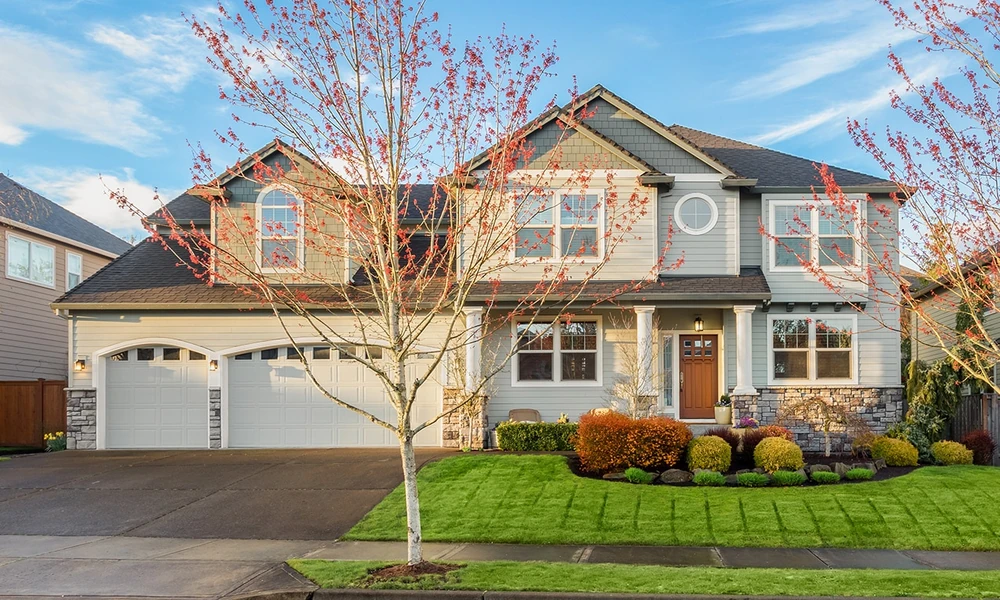
Most homeowners gut-check big projects by asking one question: will I get my money back? For windows and doors, the honest answer is mostly yes, and the reasons go deeper than a resale number on a spreadsheet. There are three separate returns at play, energy savings you collect every month you stay, a higher sale price when you do leave, and the curb appeal premium that shapes how every buyer perceives your home from the moment they park. Miss any one of those layers and you’re underestimating the real case for upgrading.
The Curb Appeal Premium Is Bigger Than Most People Think
Walk past any open house and the homes that pull you in share something obvious: a clean, well-maintained exterior. What’s less obvious is how much that first impression is worth in dollars.
Research published in The Journal of Real Estate Finance and Economics found that homes with strong curb appeal sell for an average of 7% more than comparable homes in the same neighborhood, according to a University of Texas at Arlington study reported by Phys.org in 2025. On a $350,000 home, that’s $24,500 sitting on the table before a single buyer sets foot inside.
The same research found the premium climbs as high as 14% in slower markets where housing inventory is high. That’s not a small thing. It means the payoff from improving your exterior is actually larger when competition is stiffer, which is precisely when sellers most need an edge.
Windows and doors are the face of that exterior. Cracked frames, faded trim, and fogged glass are three of the fastest ways to signal deferred maintenance to a buyer, even one who has never picked up a paintbrush in their life. Replacing them doesn’t just update a look; it removes a red flag.
What the 2025 Cost vs. Value Report Actually Says
Every year, Zonda publishes the Cost vs. Value Report, which compares average project costs against resale values across 150 U.S. markets. The 2025 edition is unambiguous about one trend: 8 of the top 10 highest-ROI projects are exterior replacements, according to the 2025 Cost vs. Value Report published by Zonda in collaboration with JLC and Remodeling Magazine.
For windows and doors specifically, the numbers look like this:
| Project | Avg. Cost Recouped at Resale (2025) | Typical Position in Report |
|---|---|---|
| Garage door replacement | ~268% | #1 nationally |
| Steel entry door replacement | ~216% | #2 nationally |
| Vinyl window replacement (10 windows) | 67% to 76% | Top exterior tier |
Source: 2025 Cost vs. Value Report, Zonda/JLC.
The entry door number deserves more attention than it gets. Swapping a tired wood door for a steel replacement is one of the cheapest projects on the list, often under $2,500 installed, and it returns more than double the investment at resale. If you own a home and haven’t replaced a dated entry door yet, that’s the single highest-leverage move available to you.
Vinyl window replacement sits at a more modest 67% to 76% return on its own, but that figure only counts resale value. It doesn’t count the monthly energy savings you bank every year you stay, which changes the calculation entirely.
“We continue to see exterior improvements drive the most value for owners selling their homes, while interior projects make the most sense for residents planning on staying in their homes for longer periods of time.” – Todd Tomalak, Principal of Building Products Advisory at Zonda, 2025 Cost vs. Value Report
The Energy Savings You Stop Counting After Year One
Here’s the part most ROI discussions skip. Windows aren’t a one-time return at closing; they pay you back every month you live in the house.
The U.S. Department of Energy reports that windows account for 25 to 30 percent of residential heating and cooling energy use, making them one of the largest sources of energy loss in a typical home. That’s a significant chunk of your utility bill leaking through your walls every season.
Replace single-pane windows with ENERGY STAR certified models and you can save between $101 and $583 per year on energy costs, depending on your climate zone, home size, and local utility rates. A climate like St. Louis, with genuinely cold winters and hot, humid summers, tends to push those savings toward the higher end of the range. Over a 10-year ownership period, the energy return alone adds up to a meaningful offset against installation costs.
The comfort factor matters too, even if it doesn’t show up in a spreadsheet. Drafts disappear. Hot spots near poorly sealed frames go away. Rooms that used to feel uncomfortable in January become livable again.
The Replace-or-Wait Matrix: A Simple Framework for Prioritizing
Not every window or door needs to go at once, and spending in the wrong order costs you. Here’s how to think through it.
- Replace immediately: Any window with broken seals (fogging between panes), visibly warped or rotting frames, or single-pane glass. These are costing you money every month and will show up on a home inspection report.
- Replace before listing: The entry door, any street-facing windows visible from the curb, and any window in a room that photographs for listings. Buyers form impressions in seconds.
- Replace on your timeline: Interior-facing or rear windows in good structural condition. They affect comfort but have the lowest impact on curb appeal and inspection outcomes.
- Wait: Newer double-pane windows with intact seals and no frame damage. Upgrading these delivers the smallest energy savings and the worst payback period of any window project.
The framework is simple: fix what’s broken and failing first, then upgrade what’s visible second. Everything else can wait for a full renovation cycle.
Choosing the Right Supplier Changes the Outcome
Window and door quality varies enormously across manufacturers, and installation quality matters just as much as the product itself. A poorly installed high-end window will underperform a correctly installed mid-range one every time. Air sealing, proper shimming, and flashing all determine whether that energy efficiency you’re paying for actually shows up on your utility bill.
This is where working with a supplier who builds to order, not off a shelf, makes a real difference. Custom sizing means no gaps, no shimming workarounds, and no thermal bridging from ill-fitting frames. Fischer Window & Door, a family-owned St. Louis business with more than 160 years of combined staff experience, makes every window and door to order, which eliminates the fit problems that undercut both energy performance and long-term durability.
That distinction is worth asking about when comparing quotes. Find out whether the product is made to your exact opening dimensions or whether installers will adapt a standard size to fit. The answer tells you a lot about what you’re actually buying.
The Bottom Line on ROI
Replacing windows and doors is not a magic number on a spreadsheet. The return comes from three separate streams: monthly energy savings that start immediately, a curb appeal premium that affects buyer perception before anyone walks through the door, and a resale value recovery that varies by material, market, and timing.
Stack all three together and the case for upgrading aged windows and a dated entry door is genuinely strong, especially in markets where exterior condition is a visible differentiator. The 2025 data on door replacement in particular is striking. An investment that returns more than double its cost at resale is rare in home improvement. The question isn’t really whether to replace your entry door; it’s why you haven’t done it yet.
What’s the oldest window in your home right now, and when did you last check the seals?
